Running a small hotel means juggling many different tasks and even though hotel management software could streamline that work, sifting through all the available vendors is a daunting task in itself. It doesn’t have to be.
Discover the perfect small hotel management software for your specific needs, as we share insider tips on picking the best provider and showcase inspiring success stories.
Best Hotel Management Systems for Small Hotels
Key Features of the Systems
Ideal Use Case
Canary
Mobile Check-in/Checkout, AI Guest Messaging, Dynamic Upsells, PCI-compliant digital authorizations
Hotels seeking a mobile-first guest engagement stack to automate front-desk operations and eliminate fraud
Mews
Cloud-native operations, modern front-desk timeline, guest self-service, open-API marketplace
Hotels looking for flexible cloud automation and extensive app integrations
Cloudbeds
Centralized Property Management System (PMS) calendar, integrated channel manager, direct booking engine
Hotels wanting a single hub to handle operations and distribution
Hotels requiring untethered mobile front-desk operations and multi-property capabilities
Little Hotelier
Simplified front desk calendar, instant 400+ online travel agencies (OTA) channel sync, direct booking engine
Hotels needing an all-in-one distribution and reservation setup
What Is Small Hotel Management Software?
Hotel management software, a term used interchangeably with property management system (PMS), is designed to be your go-to source for all things hotel operations. Typically, these systems provide solutions for tasks like booking reservations, guest check-in/checkout, assigning rooms, managing room rates and billing.
Small hotel management software handles these tasks with a special nod to the things that matter most to small business owners: getting the most out of the resources you have. These platforms automate administrative tasks and provide detailed reporting features, so you and your staff can spend more time getting to know guests and less time doing paperwork.
Best All-in-One Hotel Software for Small Properties
Choosing the right software stack is one of the most impactful decisions hoteliers make because it directly affects daily operations and guest satisfaction. Now, the best hotel tech platforms for small and independent hotels offer more than just basic front-desk tools; they are fully functional digital platforms that meet current market needs. Below, we’ll walk you through the five leading solutions designed to help smaller properties thrive in a competitive market.
1. Canary
Canary Technologies offers an end-to-end guest management platform that replaces cumbersome paper processes with a mobile-first experience with digital keys, AI-driven guest messaging and automated upselling. Streamlining front-desk duties cuts costs for boutique hoteliers and gives tech-savvy guests.
In addition to improving guest interactions, Canary prioritizes property security and fraud prevention. Its PCI-compliant digital authorizations and contactless payment tools eliminate chargebacks and protect guest data. Whether for dynamic add-ons or post-stay reviews, Canary lets small properties deliver a 5-star experience without adding to their workload.
Pros of Canary
Cons of Canary
Streamlines guest check-in, upselling and messaging
Intuitive mobile interface
Secure, PCI-compliant digital credit card authorizations
Guest experience and front-desk automation over a full, standalone PMS
Requires integration with a PMS
2. Mews
Mews is a popular cloud-native property management system among lifestyle brands and boutique hotels due to its modern operating system (OS) approach. With automation and self-service options, the platform modernizes hotel front desks and cuts manual work.
Pros of Mews
Cons of Mews
Strong automation and self-service tools
Extensive integrations via Mews Marketplace
Advanced features may require additional modules
Complex configuration and onboarding setup
3. Cloudbeds
Cloudbeds combines property management, booking tools and channel management in one platform. Independent hotels look to it for a centralized operational platform.
Pros of Cloudbeds
Cons of Cloudbeds
Integrated channel manager and booking engine
User-friendly dashboard for smaller properties
Some automation tools require higher-tier plans
Limited customization for complex operations
4. Stayntouch
Stayntouch is a mobile-first PMS designed to streamline hotel operations and guest experiences. Small hotels that want contactless service appreciate its flexible platform and multi-property management option.
Pros of Stayntouch
Cons of Stayntouch
Mobile-friendly interface for staff and guests
Contactless check-in and guest engagement tools
Smaller integration marketplace than some competitors
Reporting tools may lack depth for advanced users
5. Little Hotelier
Little Hotelier (powered by SiteMinder) is an all-in-one property management system and channel manager built specifically for small hotels, inns and B&Bs.
Pros of LittleHotelier
Cons of LittleHotelier
Easy setup and intuitive interface
Built specifically for small, independent properties
Limited scalability for growing hotel groups
Add-on pricing, such as pro-level required for guest engagement tools
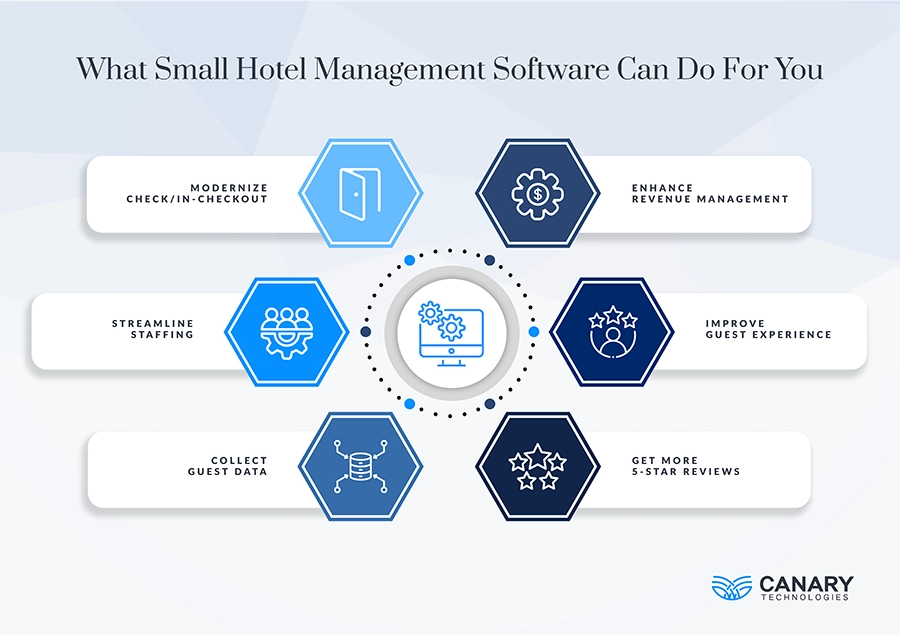
What Small Hotel Software Can Do for You
By skipping the big box solutions for small hotel software, your property (and its owners, staff and guests) can expect a number of benefits:
Modernized Check-In/Checkout
By providing a tech-forward solution for check-in and checkout, hospitality management software built for smaller properties reduces the time that hotel staff spends on repetitive tasks. Automation eliminates the need for outdated paper forms and manual data entry, and guests are treated to a modern, low-hassle experience. Examples include:
Mobile check-in to pre-register guests, reducing front desk administrative work
Mobile checkout to fast-track guest departures, minimizing front desk lines
Streamlined Staffing Operations
A centralized operations hub gives small hotel teams multiple benefits from a single, integrated system. For example, a hotel management system that allows guests to check out on their phones can alert housekeeping staff when a room has been vacated. This removes uncertainty about when rooms are ready for cleaning and speeds up room preparation for arrivals. Examples include:
A digital tipping product that allows guests to express their gratitude to staff without cash and avoids the manual splitting and distribution of credit card tips.
A post-stay system that encourages third-party reviews, notifies housekeeping when rooms are ready and checks guests out efficiently.
Guest Data Collection
Guests who prefer more personalized service often seek small hotels, and management software provides the data you need to exceed their expectations. Whether it’s reservations, finances or guest behaviors, a solid system produces insights based on your data so hotel staff can stay present with guests and find ways to make each stay better. Examples include:
A check-in product that captures email addresses so hotels can build personalized guest messaging databases.
An online webchat system that can collect information such as preferences about potential guests even before they book.
Enhanced Revenue Management
In addition to collecting guest data, small hotel management software can provide revenue insights. With metrics such as occupancy rates and booking frequency at hand, you can begin to dynamically adjust price offerings and drive ancillary revenue. Examples include:
Dynamic upselling software that offers guests the right add-ons at the right time
A mobile F&B ordering feature for your restaurant that suggests add-ons such as drinks and desserts
Improved Guest Experience
Guests are more tech-savvy than ever, and providing software solutions that streamline the experience lets small hotels compete with larger chains. Hotel technology lets guests communicate easily, find answers to common questions and feel more in control of their stay.
A digital compendium with information about all hotel features, accessible to the guest from their own device
More 5-Star Reviews
When guests use mobile checkout, they’re prompted to leave a rating. If their feedback is negative, it’s immediately sent to the front desk staff so they can rectify the situation promptly. If they leave four or more stars, guests are prompted to leave a review directly on Tripadvisor or Google.
Top Features of the Best Hotel Management Systems for Small Hotels
Every hotel has to balance income, cut expenses and simplify processes; small hotels feel this pressure more intensely because of their limited resources. As a leader of a small property, there are several features to consider when shopping around for management software:
Features of Small Hotel Management Software
Why It Matters
What to Evaluate
Reservation Management
Centralizes reservations, prevents double bookings and reduces manual data entry
Look for easy calendar views and instant status updates across booking channels with housekeeping in mind
Direct Booking Tools
Powers direct, commission-free bookings via your website
Test mobile responsiveness, how different rate types display and inventory sync with your PMS.
Guest Messaging
Speeds up communication with AI-assisted messaging, answering FAQs instantly
Look for unified inbox management, pre-arrival and post-stay messaging flows and translation capabilities
Mobile Check-In and Checkout
Conveniently reduces wait times and eliminates paper forms
Evaluate ease of guest experience, mobile key integration and post-stay review collection prompts
Payment Processing and Authorizations
Protects your business from credit card fraud and chargebacks while streamlining billing
Check for PCI compliance, contactless payment links and integration with major payment gateways
Reporting and integrations
Offers real-time visibility into KPIs
Evaluate custom reporting capabilities, depth of third-party integrations and export formats
Benefits of Boutique Hotel Management Software: 5 Success Stories
So, is investing in hotel management software really worth it? Many small hoteliers would give that question a resounding “YES” — but don’t take our word for it! These success stories show the real-world impact of investing in hotel software for small properties.
Speeding Up Check-In/Checkout: At Rosas y Xocolate, a 17-room property in Mérida, Mexico, contactless check-in has let them get more done without adding staff. Manager Christian Ix-Caamal told us they’ve seen “a 35% increase in staff efficiency…and guests love it.”
Improving Guest Satisfaction: Because guests are prompted to leave post-stay feedback as part of the checkout flow, The Waypoint Hotel, a 75-room property in Bend, Oregon, has maintained a 4.59 average guest satisfaction rating.
Adding Upsell Opportunities: NOMADS, an ultra-small, seven-room property on the Southern California coast, discovered that guests are happy to pay for things that make their stay more convenient. “It turns out guests are happy to pay the $25 for early check-in and late checkout,” their Co-Founder Sean Rowland told us.
Saving Overhead Costs: In addition to increasing efficiency, a hotel management system can trim a small hotel’s overhead costs in impactful ways. Though Mr. C Coconut Grove is a small hotel with just 100 rooms, it’s saved 700+ sheets of paper per month and cut its ink usage by 50%.
Reducing Fraud and Chargebacks: For the XV Beacon Hotel in Boston, implementing Digital Authorizations has made it much easier to prevent fraud and chargebacks for their 63 rooms — since implementing the software, they’ve reduced them by up to 90%.
What Are the Key Factors to Consider When Choosing a Hotel Management Software for a Boutique Hotel?
Choosing the right hotel management software for a boutique hotel comes down to evaluating your core operational goals, feature requirements, vendor support, ease of implementation and scalability against your property's unique guest experience model. Because no two boutique hotels operate the same way, identifying your specific operational priorities before shopping around ensures you select a platform built to fit your workflow rather than forcing your staff into a rigid tool.
Consider these key factors when deciding on software:
1. Your Goals for Hotel Management
One of the main benefits of small hotels is that they’re unique, but so are their goals. For example, some hotels may want to focus more on streamlining operations, while others may be primarily interested in adding ancillary revenue. Whatever your goals are, they’ll provide you with a great foundation to start as you decide which system is the best fit.
2. A Platform’s Key Features
Some hotel management systems are built as all-in-one packages, while others allow hoteliers to pick and choose what they’d like. As you shop around, consider the key guest management features you’d like to see and make sure the platforms you look into check all the boxes and have room for you to add on as your operations grow.
3. The Support You Can Expect
Hotels are 24/7 operations, so any software you invest in should operate around the clock, too. If hotel staff have a question in the middle of the night or there’s a software bug that needs reporting, will the software provider be there to help you? Make sure to clarify what kind of customer service they provide in case anything does go wrong.
4. Ease of Implementation
Adding a new system is supposed to alleviate issues, not cause them. It’s wise to make sure that any system you opt for is easy to set up and learn so your staff can quickly get up to speed. Many providers have resources to help with this process, which is worth asking about.
Simplify Small Hotel Management with Canary
Managing a small or boutique hotel requires wearing a dozen hats at once, from overseeing front-desk arrivals and housekeeping schedules to tracking down unpaid folios and driving direct revenues. With the right small-hotel management software, you can free your team from repetitive administrative tasks so they can deliver the memorable, high-touch hospitality that keeps guests returning. The results speak for themselves: small hotels using Canary routinely boost their revenue by thousands of dollars per month while improving overall staff efficiency by up to 50%.
Canary Technologies creates mobile-first guest management solutions built for independent hoteliers so they outperform their competition by:
Automating key touchpoints: Streamline arrival and departure with digital check-in and checkout.
Driving ancillary revenue: Capture additional income effortlessly through dynamic, automated upselling.
Securing property operations: Eliminate credit card chargebacks and fraud with PCI-compliant digital authorizations
Ready to upgrade your guest experience and streamline your daily operations? Book a demo with Canary today to see what our platform can do for your property.
Frequently Asked Questions
What software solutions do small hotels use to manage operations?
Small hotels typically rely on a PMS combined with an online booking engine, a channel manager and a guest experience platform.
Which hotel software vendors work best for small hotels?
Small hotels need vendors that specialize in hospitality and offer flexible options beyond standard packages. Vendors like Canary are consistently recognized across review websites such as G2, Capterra and credited by industry awards as the best option for small, boutique and independent properties.
What is the difference between hotel management software and small hotel reservation software?
Small hotel reservation systems are one component of hotel management software. Depending on your hotel’s priorities, other parts include payment processing, guest messaging, reporting and more.
Can motel software solutions help manage guest communication?
Modern guest engagement solutions, such as Canary, work for motels and span text and WhatsApp, incorporating AI messaging to handle routine guest inquiries.
How much does software for small hotels cost?
Pricing typically depends on your room count and feature requirements. Most vendors charge either a flat monthly subscription or a per-room, per-month fee.